
Awareness campaigns like Elder Abuse Awareness Month amplify the message through local media, community partnerships, and digital outreach. These efforts remind families and caregivers to have open conversations about finances and to regularly check in on loved ones’ accounts and transactions.
In this blog, we’ll provide answers to common questions about these heinous crimes and what is being done to combat them.
The latest data from the FTC shows reported losses totaling $15.9 billion in 2025; however, that figure is likely only part of the story, with the true cost of fraud potentially reaching as much as $195.9 billion when accounting for unreported cases.
In addition to the overwhelming scale of the problem, recovering losses can also be extremely difficult as investigations into these networks are complex and time-consuming. Even when law enforcement has IP addresses, cryptocurrency wallet information, call center numbers, or mule accounts, building prosecutable cases can take years. That timeline is devastating for older victims, and often agencies facing violent crime, narcotics, and national security pressures can’t devote resources to combat the issue due to insufficient funding.
In addition to the outreach efforts highlighted in last month’s post on National Senior Fraud Awareness Day, at American Riviera Bank we continue to invest in new technology to stop fraud before it starts.
Fraud experts monitor transactions for anomalies: Effective protection against elder financial abuse requires a multi-pronged approach. Banks and financial institutions are not only monitoring transactions for red flags but also investing in educational programs and building awareness in the communities they serve. Regular account monitoring helps detect unusual withdrawals, changes to contact information, or the addition of new authorized users, which are often early indicators of potential abuse.
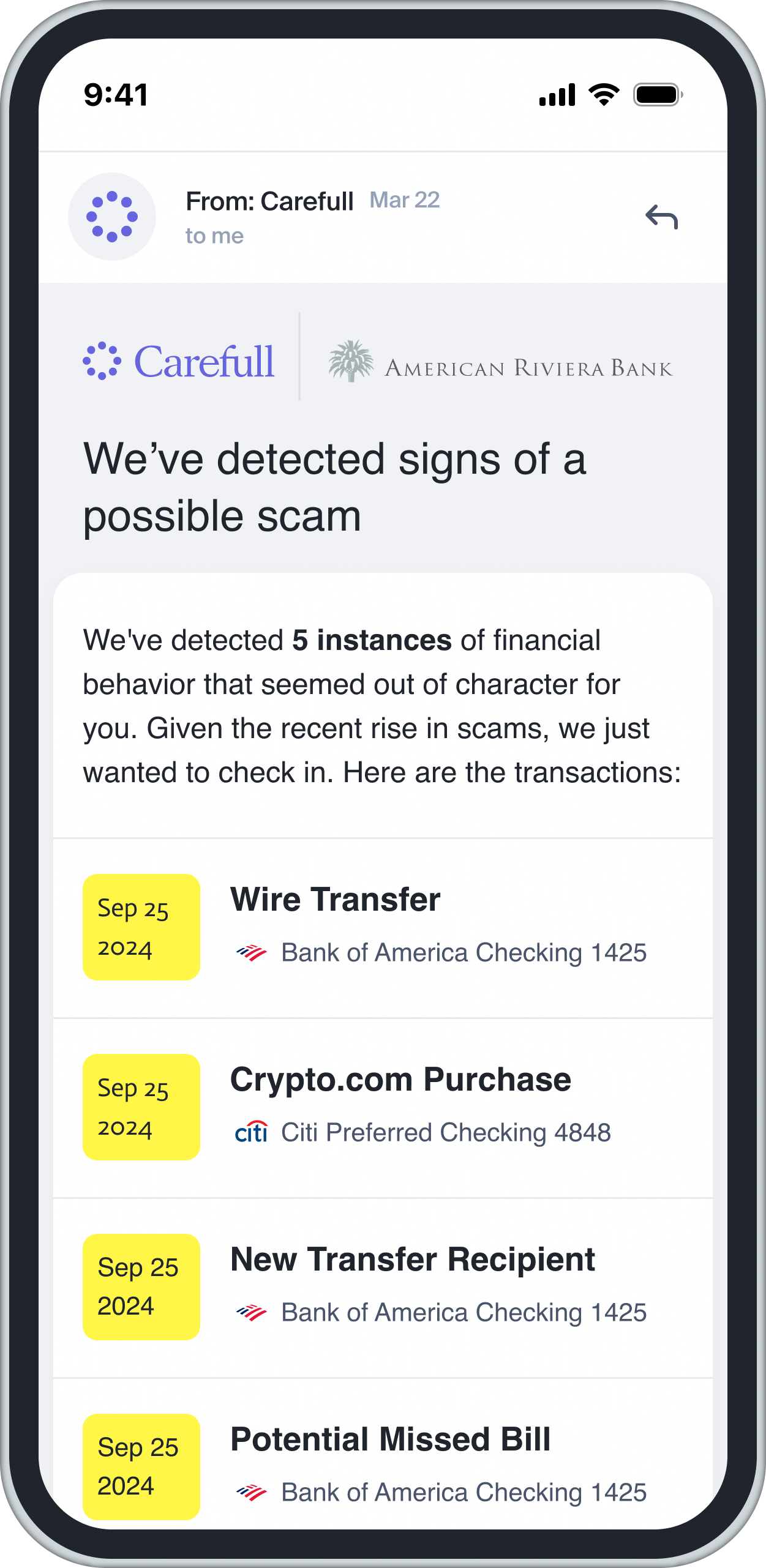
Client tools: Our Carefull Companion App, offered free to all ARB clients, is another key resource in the fight against elder financial exploitation. The app offers real-time account monitoring, alerts for suspicious activity, and a secure platform for families to collaborate in managing finances. With features designed specifically for older adults and their trusted contacts, the Carefull Companion App helps bridge gaps in communication and oversight, ensuring that questionable transactions are quickly identified and addressed.
Online Resources: In addition, we encourage all clients and their families to take advantage of resources through our .BANK website. Our toolkits, helplines, and online guides offer step-by-step advice for recognizing scams, reporting suspected abuse, and recovering from financial loss.
The National Adult Protective Services Association (NAPSA) plays a critical role in the fight against elder financial abuse. NAPSA supports and advocates for Adult Protective Services programs across the United States, offering resources and training for professionals who investigate and intervene in cases of elder abuse, including financial exploitation. NAPSA also collaborates with local and federal agencies to improve reporting, response protocols, and public awareness campaigns.
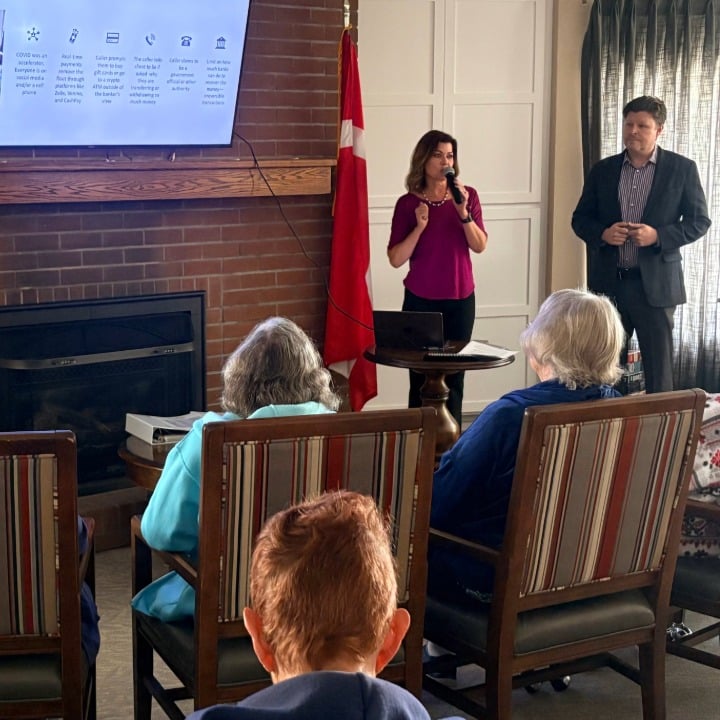
In recognition of World Elder Abuse Awareness Day (WEAAD), the NAPSA Committee Against Financial Exploitation (CAFE) hosted an important webinar on how to better support older and vulnerable adults impacted by international scams. I was honored to participate in this discussion, presenting on strategies employed by banks to prevent elder financial abuse.
The American Association of Retired Persons (AARP) is another influential organization working to protect seniors from fraud. Through its Fraud Watch Network, AARP provides educational materials, scam alerts, and a helpline for victims of financial crime. The network partners with law enforcement and consumer protection agencies to disseminate information and assist with investigations. AARP regularly publishes research and reports on scam trends targeting older adults.
Other contributors include the Consumer Financial Protection Bureau (CFPB), which enforces laws against financial exploitation and offers guides for seniors and caregivers; the Elder Justice Initiative at the U.S. Department of Justice, which coordinates national efforts and provides resources for prosecutors and victims; and the Securities and Exchange Commission (SEC), which educates older investors about fraud risks. The American Bankers Association Foundation also provides resources to assist banks in training through their Safe Banking for Seniors program. Partnerships between these agencies and nonprofit organizations help amplify outreach and provide comprehensive support for victims.
Local police and APS reports are also filed, but unfortunately, APS investigators may be hampered from being able to investigate elder financial abuse reports if the victim refuses assistance. Oftentimes it takes months, if not years, to convince a victim they are being defrauded due to the effectiveness of the scammer tactics.
Thousands of fraud cases sit physically boxed and shelved—bankers boxes filled with reports that no single agency has the time, jurisdiction, or connective data to pursue meaningfully. Local police departments, federal prosecutors, and DOJ offices face the same constraint: triage. The volume is simply too large for the traditional, government‑only response model. Cases involving older adults often stall - not because they lack merit, but because they lack scale.
In addition, without aggregation, these cases rarely meet prosecutorial thresholds. As AARP explains, $10,000 or $25,000 losses scattered across the country often never gain traction until they are linked together. Federal and nonprofit reporting confirms that a significant portion of fraud is perpetrated by organized criminal networks, many operating outside U.S. borders, using multiple platforms and financial rails as part of complex money movement techniques to make the money harder to track.
When those efforts fail, the next best step is to report the crimes. There is still no solution at the federal level, as elder financial abuse laws are enforced at the state level; however, there have been several non-profits who have risen to the challenge to connect the dots in a case. Building on the model of the FBI San Diego’s Elder Justice Task Force, the National Elder Fraud Coordination Center (NEFCC) was launched in April 2025 to build high-dollar cases against criminals targeting older adults by aggregating cases nationally and packaging them into high‑value investigative referrals for prosecutors. The NEFCC aggregates data from both private companies and public sources, and identifies connections across thousands of small cases to develop comprehensive cases for law enforcement. These packages are then shared with DOJ attorneys and law enforcement partners to create the scale needed for a prosecution.
The National Cyber‑Forensics and Training Alliance (NCFTA), a nonprofit formed in 2002, has become an international model for bringing together law enforcement, private industry, and academia to share threat intelligence to stop emerging cyber threats and mitigate existing ones. The NCFTA deals with malicious computer viruses, telecommunication scams, and other financial frauds perpetrated by organized crime groups.
Working with law enforcement: While victims can report fraud through channels such as the Internet Crime Complaint Center (IC3) and the Federal Trade Commission (FTC), they oftentimes do not have sufficient knowledge of the details to prepare a meaningful report that can be picked up by law enforcement. This is why, at American Riviera Bank, we also assist clients with filing reports with agencies like the FBI at IC3.gov, the USPIS at www.uspis.gov/report, and the FTC at www.reportfraud.ftc.gov. We also report to regulatory agencies such as FinCEN to enable law enforcement access to our investigative findings. It is imperative that bad-actor data be shared by banks when investigating a report, as the data allows for cross-sector analysis to join cases nationally.
Resources for Victims: We published a blog last month in honor of National Senior Fraud Awareness Day that included a list of resources, including the National Elder Fraud Hotline. If you or a loved one has been impacted by elder financial fraud, call the National Elder Fraud Hotline at 1-833-372-8311. The hotline provides support, resources, and guidance for victims and their families, and can even help in filing reports. Victims can be proactive in collecting fraud data to facilitate more meaningful reports.
Key data points include:
At times it may seem as though bankers are asking too many questions regarding your financial transactions. This is because our bankers are highly trained to recognize red flags and want to protect you and your loved ones from financial fraud. In addition, every piece of data we collect, from text messages to email addresses from criminals, can be a key to a successful investigation. On their own, these signals may not justify a case, but collectively, they may reveal organized criminal patterns and allow law enforcement to pursue networks rather than isolated criminals.
Our branch staff, fraud investigators, and cybersecurity personnel may only see pieces of these larger cases, but we believe every contribution matters. Even when a single referral doesn’t lead to an immediate arrest, it may become the missing link in a much larger case months or years later. AARP and NEFCC both stress that even small contributions—alerts, referrals, or indicators—can become decisive when combined with national data sets, even if we never learn which data point ultimately enabled prosecution.
Elder financial abuse is organized, global, and accelerating. Fighting it one case at a time is no longer enough. The future of elder protection lies in:
Sharing is no longer optional; It is what will make the difference in meaningful recoveries and preventing the bad guys from stealing from their next victim. At American Riviera Bank, during Elder Abuse Awareness Month and throughout the year, we are deeply committed to playing our part and doing everything possible to protect our community from these crimes.
As we wrap up June, we’re reminded how important it is to look out for older adults in our community and stay mindful of their increased risk of financial exploitation. At American Riviera Bank, protecting our clients goes beyond monitoring accounts. It means taking the time to listen, asking the right questions, and showing up as a trusted resource to the community.
Previous: Village at PCH Workforce Housing Next: BIMI Logomark